How to Buy Land in Texas: A Step-by-Step Guide
Buying land in Texas takes five steps: set your purpose and budget, choose a region, arrange financing, check the land, and close through a title company. The steps are simple, but Texas puts more of the checking on you than most states do. Counties here cannot zone land, so outside city limits there is often no local office telling you what a tract can be used for (Texas Real Estate Research Center).
At Landapaloozas we sell owner-financed land in Texas and eleven other states, so we see this process from the seller’s side every week. This guide shows you how to purchase land in Texas the way a careful buyer does it, with current prices, loan options, and a checklist you can take to the property.
How to buy land in Texas:
Buying land in Texas involves several important steps, from deciding how you plan to use the property to completing the purchase. You’ll need to set a realistic budget, choose a suitable location, explore financing options, and carefully check the land for potential issues before making an offer. Each step helps you avoid costly mistakes and make a more informed decision. Here’s a quick overview of the five main steps, along with the people or professionals who can help you through the process.
| Step | What you do | Who helps |
|---|---|---|
| 1. Purpose and budget | Decide how you will use the land and what you can spend in total | You |
| 2. Region | Match your purpose to a part of Texas you can afford | Local agent or seller |
| 3. Financing | Pick cash, a land loan, a veteran or farm program, or owner financing | Lender or seller |
| 4. Due diligence | Check title, survey, access, water, minerals, flood risk, and restrictions | Title company, surveyor, county offices |
| 5. Offer and closing | Sign a contract, review the title commitment, close, and record the deed | Title company, attorney |
How much does it cost to buy land in Texas?
Rural land in Texas sold for a statewide median of $5,218 per acre in the second quarter of 2026, up 3.27% from a year earlier. That figure comes from the Texas Real Estate Research Center at Texas A&M University, which tracks verified rural land sales. Where you buy changes the price far more than when you buy, as the table shows.
| Texas region | Median price per acre (Q2 2026) | Change from a year earlier |
|---|---|---|
| Far West Texas | $1,139 | +73.89% (small sample of sales) |
| Panhandle and South Plains | $1,719 | -7.53% |
| West Texas | $3,008 | +14.29% |
| South Texas | $6,225 | +0.99% |
| Austin, Waco and Hill Country | $8,040 | +8.63% |
| Northeast Texas | $8,604 | -5.96% |
| Gulf Coast and Brazos Bottom | $11,369 | +3.05% |
Source: Texas Rural Land Markets, Second Quarter 2026, Texas Real Estate Research Center.
Small tracts cost more per acre
The regional medians above lean toward larger ranch tracts. If you want 5, 10 or 20 acres, expect a higher price per acre. At the end of 2025, small tracts sold for about $17,529 per acre in the Hill Country and $8,330 in West Texas, while large West Texas tracts sold for $2,878 (Texas Real Estate Research Center).
So do not multiply the regional median by your acreage and call it a budget. Compare recent sales of tracts the same size, in the same county, with the same road and utility access.
Costs beyond the purchase price
Besides the land’s purchase price, you’ll need to account for several additional expenses when buying property in Texas. These costs can vary depending on the property’s location, size, condition, and financing method. Some are paid upfront during closing, while others, such as property taxes and utility installations, may continue after the purchase.
| Cost | What to know |
|---|---|
| Down payment | About 20% with a rural lender, 5% with the Veterans Land Board, and often less with owner financing (details in Step 3) |
| Title insurance | The premium is set by the state, so every title company charges the same for the same policy amount. Rates dropped 6.2% on March 1, 2026 (Texas Department of Insurance) |
| Survey | Priced by acreage, terrain and how old the existing records are. See our land survey cost guide |
| Escrow and recording fees | These vary by title company, so compare them |
| Septic and well | Needed on most rural tracts with no city service. See our septic cost and perc test guide |
| Property taxes | Paid every year to the county, and much lower if the land holds an agricultural valuation |
Step 1: Decide your purpose and set a full budget
Your purpose decides almost everything that follows: how many acres you need, which region fits, which loan you can get, and what you must check. A tract that is perfect for hunting can be useless for a house if it floods or has no legal road. Write the purpose down before you look at a single listing.
| Your purpose | What matters most |
|---|---|
| Build a home | Legal access, utilities, septic-friendly soil, flood zone, deed restrictions |
| Recreation or hunting | Water, cover, shape of the tract, neighbors, existing leases |
| Farming or ranching | Soil, water rights, fencing, agricultural tax valuation |
| Investment | Road frontage, growth nearby, low holding costs, clean title |
Then set a budget for the whole project, not only the price. Add the down payment, closing costs, survey, the first year of taxes, and any work the land needs, such as a driveway, well, septic system or power line. Buyers who budget only for the price are the ones who own land they cannot afford to use.
If land terms are new to you, keep our land buying glossary open while you shop. If you are buying mainly to hold and resell, read is land a good investment first.
Step 2: Choose where to buy land in Texas
There is no single best place to buy land in Texas. The best place is the region where your purpose and your budget meet. Use the price table above as a first filter, then narrow down to two or three counties you can visit in person.
| If you want | Look at | Why |
|---|---|---|
| The lowest price per acre | Far West Texas, the Panhandle, West Texas | Regional medians run from about $1,100 to $3,000 per acre |
| A balance of price and access to cities | South Texas, Northeast Texas | Mid-range medians of about $6,200 to $8,600 per acre |
| Land near fast-growing metros | Hill Country, Gulf Coast | The highest medians, from about $8,000 to $11,400 per acre |
Cheap land is cheap for a reason, and in West Texas that reason is usually water and distance. Before you fall for a low price, confirm how far the nearest power line, paved road and town are. You can browse our current land for sale in Texas, or compare Texas with other states in the cheapest places to buy land in America.
Step 3: How to finance land in Texas
A regular home mortgage does not work for raw land, because there is no house to secure the loan. Land loans ask for more money down and are offered by fewer lenders. Texas buyers have five realistic ways to pay, and the right one depends on your savings, your credit, and whether you qualify for a veteran or farm program.
| Option | Down payment | Key terms | Best for |
|---|---|---|---|
| Cash | 100% | No interest, fastest closing, strongest offer | Small tracts and buyers with savings |
| Rural lender or Farm Credit | Typically 20% | Rate can be locked from 1 to 20 years (Texas Farm Credit) | Buyers with good credit and steady income |
| Texas Veterans Land Board | Minimum 5% | Up to $200,000, 30-year fixed rate, at least 1 acre (Texas General Land Office) | Texas veterans and military members |
| USDA Farm Service Agency | 5% under the Down Payment Program | Direct farm ownership loans up to $600,000 (USDA FSA) | Beginning farmers and ranchers |
| Owner financing | Set by the seller, often low | No bank, monthly payments made to the seller | Buyers with thin credit or small savings |
Loans for land in Texas from banks and Farm Credit
Rural lenders look at your credit, your income, and the land itself. They want legal access, a survey, and a clear title before they lend. Co-op lenders in the Farm Credit system may also return part of their earnings to borrowers as a cash dividend, which lowers the real cost of the loan.
Ask every lender the same four questions: the down payment, the rate and how long it is fixed, the loan term, and whether there is a prepayment penalty. Our guide to land financing options explains each loan type in more depth.
The Texas Veterans Land Board loan
Texas is the only state with its own land loan for veterans. The Veterans Land Board lends up to $200,000 on tracts of one acre or more, with a minimum 5% down payment and a 30-year fixed rate. Two eligible veterans who are married can borrow up to $275,000 on the same tract.
The posted rate was 7.25% when we checked in November 2026, and there is a $325 appraisal and contract fee with no prepayment penalty. The land must sit wholly inside Texas and have legal, usable access to a public road. Check the VLB land loan page for the current rate before you apply.
USDA loans for beginning farmers
If you plan to farm or ranch the land, the Farm Service Agency has a Down Payment Program. You put down at least 5% in cash, FSA lends up to 45% of the price for 20 years at a reduced rate, and a commercial lender covers the rest. You must not have operated a farm for more than 10 years to count as a beginning farmer.
How to buy land in Texas with no money
Buying land with truly zero dollars is rare, and any ad that promises it deserves a second look. What is realistic is buying with very little money up front. These are the routes that work:
- Owner financing with a low down payment. The seller carries the loan, so there is no bank minimum to meet.
- The 5% programs. The Veterans Land Board and the FSA Down Payment Program both start at 5% down if you qualify.
- Equity you already own. Some lenders let you pledge a paid-off home or other land instead of cash.
- A partner. Two buyers can split the down payment and hold title together.
We cover each route in how to buy land with no money.
How owner financing works, and what to check
With owner financing you pay the seller a down payment and then monthly payments until the balance is cleared. At Landapaloozas we finance our own properties with no bank and no credit check, there is no prepayment penalty, and the deed transfers to you when the balance is paid in full. Down payments are shown on each listing.
Before you sign any owner-financed deal in Texas, with us or anyone else, ask these questions:
- When does the deed transfer: at closing, or after the last payment?
- What are the interest rate, the monthly payment, and the total you will pay?
- Who pays the property taxes during the contract?
- What happens if you miss a payment, and how long do you have to catch up?
Texas law gives extra protection when you buy land for your home under a contract that lasts longer than 180 days. The seller must give you a survey no more than one year old, record the contract within 30 days, send you an accounting statement every January, and deliver the deed within 30 days of your final payment (TexasLawHelp). Ask the seller how they handle each of these.
Step 4: What to consider when buying land in Texas
This is the step that protects your money. Land has no inspection report like a house, so you build your own from public records and a site visit. Work through the checks below before your option period ends, while you can still walk away.
Title and survey
The title commitment and the survey do different jobs, and you need both. The title commitment lists who owns the land and what is recorded against it. Read Schedule B closely, because that is where recorded deed restrictions and easements appear. The survey shows where the boundaries, fences, roads and encroachments are on the ground.
A standard title policy does not cover boundary disputes with neighbors unless you buy extra coverage, according to the Texas Department of Insurance. That is the main reason to order a new survey on an old tract. Our guide to boundary survey costs explains what drives the price.
Legal access
A road you can drive on is not the same as a road you have the right to use. If the tract does not touch a public road, you need a recorded, deeded easement across the neighbor’s land. A handshake agreement with the current neighbor ends the day that neighbor sells.
Lenders treat access as a deal breaker. The Veterans Land Board, for example, will not finance a tract without legal, usable access that a passenger car can drive in bad weather. Visit after heavy rain if you can, since low-water crossings and dirt county roads show their problems then.
Water, utilities and septic
Ask three things about water: is there a public or rural water line, is there an existing well, and does a local groundwater district limit new wells. Then get a written estimate from the electric co-op for extending power to your build site. Line extensions are priced by distance, so a tract half a mile from the nearest pole can cost far more than it looks.
Most rural homes need a septic system, which Texas calls an on-site sewage facility. You need a permit and an approved plan from the local permitting authority before you build one, and a licensed site evaluator must test the soil first (TCEQ). A single home on 10 acres or more can be exempt from the state permit, but many counties are stricter, so call the county before you rely on that.
Flood risk and soil
Look up the tract on the FEMA Flood Map Service Center. Land in a mapped floodplain can still be good for grazing or hunting, but it limits where you can build and adds insurance cost. Ask whether creeks and ponds hold water all year or only after rain.
Soil matters for two reasons. Sandy or rocky soil can fail a septic evaluation, and the expansive clay found across much of Texas moves enough to crack a foundation. If you plan to build, a soil report before closing is cheap insurance.
Mineral, wind and water rights
In Texas the minerals under the land are often owned by someone other than the surface owner. When minerals were severed in the past, the mineral owner may have the right to use the surface to reach them. Ask what conveys with the sale, and whether a surface use waiver is in place.
You can check for wells and pipelines on the public map viewer at the Railroad Commission of Texas. Ask about wind and solar leases too. Our mineral rights guide covers the wording to look for in the contract.
Restrictions and local rules
Texas counties have no general zoning power, so on rural land the rules that bind you are mostly private. Deed restrictions are recorded with the county and stay with the land, even if the seller never mentions them. They can limit mobile homes, livestock, home size, or how the tract can be divided.
Also ask if the land sits inside a city’s extraterritorial jurisdiction, a ring that reaches from half a mile to five miles past the city limits, where the city controls platting (Texas Real Estate Research Center). For more on this, read what unrestricted land means and how setback requirements work.
The rest of the checklist
| Check | Why it matters | Where to verify |
|---|---|---|
| Unpaid property taxes | Tax liens follow the land, not the seller | County tax office |
| Easements | Power lines, pipelines and shared roads limit where you can build | Title commitment and survey |
| Existing leases | Grazing or hunting leases may continue after you buy | Seller and lease documents |
| Past use | Old dumps, tanks or oilfield sites can mean cleanup costs | Seller, neighbors, Railroad Commission map |
| Shape of the tract | Long, narrow tracts cost more to fence and are harder to manage | Survey |
| Neighbors and noise | Highways, rail lines and nearby land uses affect privacy | Site visit at different times of day |
| Timber | In East Texas, standing timber can be a large share of the value | Consulting forester |
| Protected species | Protected wildlife can restrict clearing | Texas Parks and Wildlife biologist |
One habit pays off on every tract: talk to a neighbor. Neighbors know which road floods, where the old fence line really ran, and why the last sale fell through. Ten minutes at a fence can save you weeks of record searches.
Step 5: Make an offer and close
A land purchase in Texas usually closes at a title company, which holds the money, clears the title and records the deed. If an agent is involved, the offer is normally written on a standard contract form published by the Texas Real Estate Commission. The closing itself follows the same order almost every time.
- Make a written offer. State the price, the earnest money, the closing date, and who pays for the survey and the title policy. Who pays the title premium is open to negotiation.
- Buy an option period. For a small fee you get a set number of days to inspect the land and cancel for any reason. Make it long enough to finish the Step 4 checks.
- Deposit earnest money. The title company holds it and opens the title search.
- Review the title commitment and survey. Send written objections to anything you do not accept, such as an unknown easement or a lien.
- Lock your financing. Give the lender the survey, the commitment and anything else it asks for.
- Close and record. You sign, pay, and receive the deed. The title company records it with the county clerk and issues your owner’s title policy.
Ask for a general warranty deed when you can, because it gives the buyer the strongest promise about the title. Our guides explain what a warranty deed is and the difference between a deed and a title.
Texas does not require title insurance unless a lender is involved. Buy the owner’s policy anyway. You pay the premium once at closing, and it protects you for as long as you own the land.
Property taxes and the Texas agricultural valuation
Property tax is the main yearly cost of owning Texas land, and the agricultural valuation is the main way to reduce it. People call it the ag exemption, but it is really a different way of valuing the land. Qualifying land is taxed on what it can produce as farm or ranch land, not on its market price.
The Texas Comptroller sets three main tests:
- The land is used mainly for agriculture, such as crops, livestock or hay.
- It is used to the level of intensity that is normal for the area.
- It has been in agricultural or timber use for at least five of the past seven years.
Land that already qualifies can also switch to wildlife management and keep the lower valuation. The owner must carry out at least three of seven approved wildlife practices. This suits buyers who want recreation land but do not want to run cattle.
What buyers should do about it
Ask the seller for proof that the valuation is in place, and call the county appraisal district to confirm it. Each district sets its own intensity standards, including minimum acreage, so there is no single statewide number. After closing, file a new application in your own name.
Watch out for the rollback tax. If you change the land to a non-agricultural use, you owe the difference between the agricultural tax and the market-value tax for each of the previous three years. Ask the appraisal district what the rollback would be before you clear a homesite or subdivide.
How to buy land and build a house in Texas
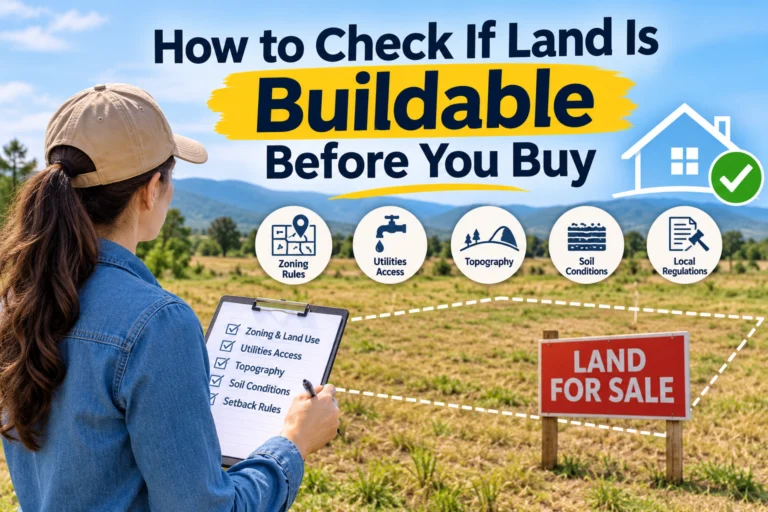
If a home is the goal, confirm the tract is buildable before you close, not after. A tract can have clean title and a fair price and still fail as a homesite because of a floodplain, a failed soil test, or a deed restriction on home size. Our checklist on how to find out if land is buildable walks through each test.
Follow this order so you do not pay for the same work twice:
- Pick the build site first. Walk the land with your builder or designer and mark where the house, driveway, well and septic field would go.
- Confirm the rules. Read the deed restrictions and ask the county about driveway permits, floodplain permits and septic rules.
- Price the utilities. Get written quotes for power, water and septic to that exact site.
- Arrange the money. Many buyers use a land loan now and a construction loan later, which means two closings and two sets of closing costs. Some rural lenders offer a single-close loan that covers both (Texas Farm Credit).
- Close, then permit and build. Get the septic permit approved before any dirt work starts.
Texas has no statewide minimum lot size for a house. In practice the limit comes from the septic system, the well, and any deed restrictions. Counties may apply a building code to single-family homes, but they cannot regulate manufactured or modular homes that way, so deed restrictions usually decide whether one is allowed (Texas Real Estate Research Center).
If the tract has an agricultural valuation, read our guide on building a house on agricultural land before you break ground, since taking the homesite out of agricultural use can trigger the rollback tax.
Mistakes we see Texas land buyers make
- Buying sight unseen. Photos hide slope, trash, neighbors and washed-out roads. Visit, or pay someone local to walk it for you.
- Trusting the fence. Old fences are often not on the boundary. Only a survey settles it.
- Assuming “unrestricted” means no rules. Septic, floodplain and platting rules still apply, and so do recorded easements.
- Skipping the option period. Without it you can lose your earnest money if you find a problem.
- Treating the ag valuation as automatic. It does not carry over in your name until you apply and keep the land in qualifying use.
- Forgetting holding costs. Taxes, association dues and insurance continue while the land sits empty. See whether you need vacant land insurance.
Your next step
Pick your purpose, set the full budget, and shortlist two or three counties this week. Then take the Step 4 checklist to every tract you visit. When you are ready to look at real properties, see our owner-financed land in Texas or contact us with questions about a specific parcel.
This guide is general information, not legal, tax or financial advice. Rates, prices and program limits were checked in November 2026 and can change.
Frequently Asked Questions
Can I buy land in Texas if I live in another state?+
Yes. You do not need to live in Texas to own land here, and title companies can handle a closing by mail. Some programs do require residency, including the Veterans Land Board loan. If you are not a U.S. citizen, read our guide on whether a foreigner can buy property in the US and speak with a Texas attorney first.
Do I need a real estate agent or an attorney to buy land in Texas?+
Neither is required by law. A local land agent helps most with pricing and with spotting problems on the ground. An attorney is worth the fee when the deal involves owner financing, an access easement, severed minerals, or a contract the seller wrote.
How many acres do I need for an ag valuation in Texas?+
There is no statewide number. Each county appraisal district sets its own standards for how intensively the land must be used, and many set a minimum acreage for each type of use. Call the district for the county you are buying in.
Is buying land in Texas a good investment?+
It can be, but it is not guaranteed. The statewide median rose 3.27% in the year to mid-2026, yet prices fell 7.53% in the Panhandle and 5.96% in Northeast Texas over the same period (Texas Real Estate Research Center). Land also produces no income unless you lease it, so plan to hold it for years.
Can I buy land in Texas with bad credit?+
Banks and Farm Credit lenders check credit, so a low score makes a land loan hard to get. Owner financing is the usual route, because the seller decides the terms. Compare the total cost, not just the monthly payment, before you commit.