Land Buying Terms Glossary: 50+ Terms to Know
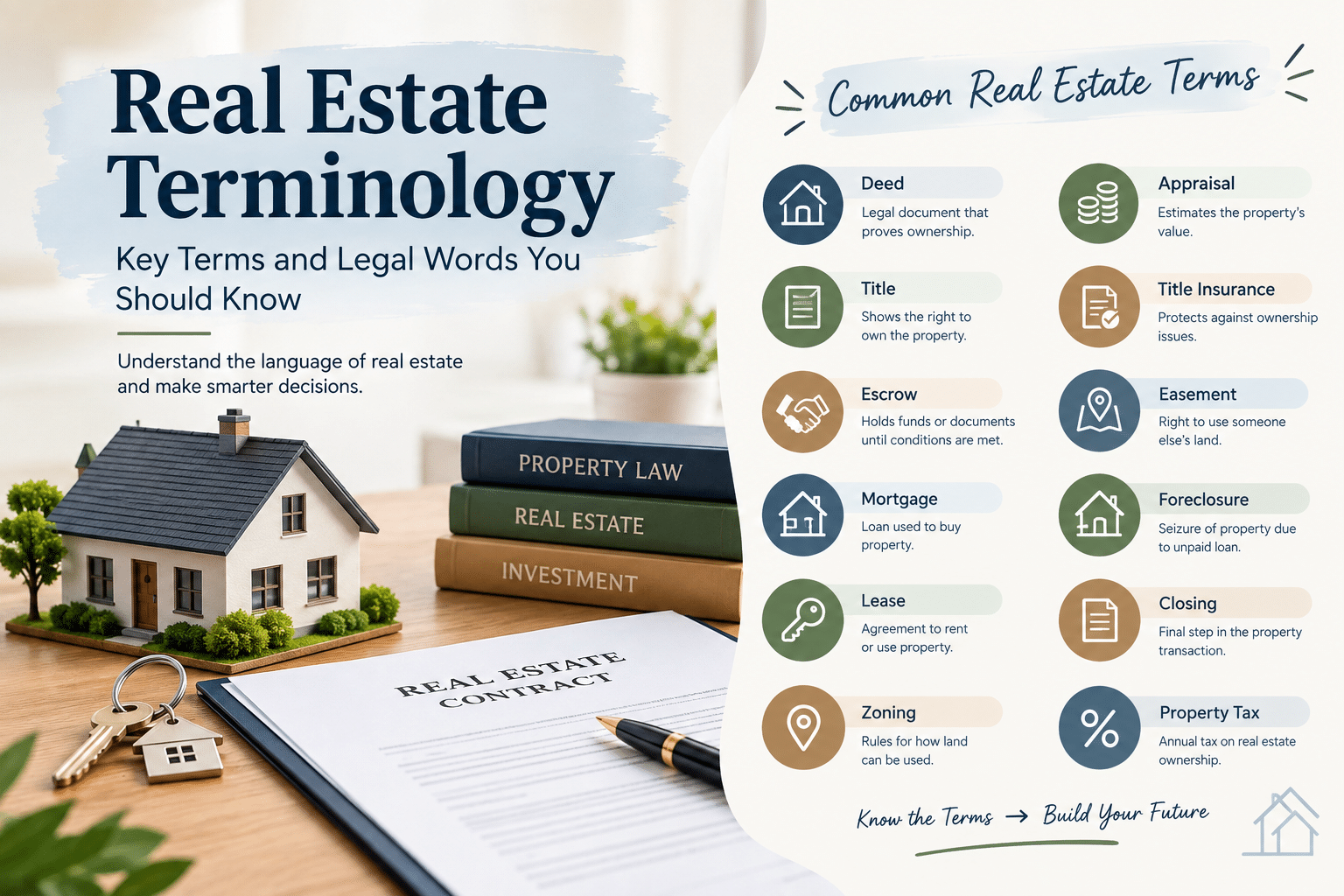
Buying raw land means reading documents full of words a house closing never uses—metes and bounds, perc test, ingress/egress, contract for deed. This glossary covers more than 50 of them, grouped the way you actually run into them: a cluster of legal description terms when you’re reading a deed, a cluster of access and zoning terms when you’re checking a parcel with the county, a cluster of financing terms a week later when you’re looking at a contract for deed. That’s more useful than an A-Z list where related terms sit pages apart.
A house glossary with a few land words bolted on won’t cover what you’re about to deal with. Vacant land and rural acreage carry their own vocabulary—easements, perc tests, metes and bounds, landlocked parcels, deed restrictions—and none of it is optional reading. Miss what an easement on your deed actually covers, or skip confirming a perc test is current, and you can end up with a parcel you can’t reach or can’t build on, sometimes not finding the problem until you try to sell. Each section below defines the term plainly, then tells you what to check or ask before you rely on it. If a term here leaves you with a question specific to your situation, our Frequently Asked Questions page covers a lot of what buyers ask next.
Land and Property Description Terms
Every deed describes a piece of land in a specific, technical way long before anyone talks about zoning or price. These are the terms that do that job—the ones printed on the deed and the survey, describing size, shape, and boundaries. Get one of them wrong and you can end up confused about exactly what you bought, or worse, arguing with a neighbor over where your line actually sits.
- Acreage: the total size of a parcel measured in acres. Listings round this number, so don’t treat it as exact until a survey confirms it.
- Parcel: a distinct piece of land identified by the county, usually tied to a parcel number used for taxes and recording.
- Lot vs. tract: a lot is a parcel within a platted subdivision with recorded lines; a tract is a larger, often unplatted piece of acreage that hasn’t been formally subdivided. Rural land is far more likely to be sold as a tract.
- Legal description: the written text on a deed that identifies the exact property being conveyed—this is what actually transfers in a sale, not the street address or listing photos.
- Metes and bounds: what does metes and bounds mean? It’s a legal description that locates boundaries by distances and compass directions, starting and ending at a fixed point of beginning. You’ll see this a lot on older rural tracts instead of a lot-and-block description, which just references a recorded plat map.
- Plat map: a recorded map showing how a larger piece of land was divided into lots, with dimensions and easements marked.
- Survey: a current, on-the-ground measurement of the property’s actual boundaries, done by a licensed surveyor. I’d never close on raw acreage without one, even when the seller swears the old survey is still good.
- Frontage: how much of the parcel touches a road, lake, or other feature—this affects both access and value.
Ask which description type shows up on your deed, then get a current survey before closing. Old metes-and-bounds descriptions drift when markers disappear, and that’s exactly where boundary disputes start.
Access, Zoning and Land Use Terms
Once you know how a parcel is described on paper, the next question is a practical one: can you actually get to it, and what are you allowed to do once you’re standing on it? This is where most land deals go sideways, more than title problems or financing fine print. A listing can say “zoned residential” and still leave you unable to park the RV you planned on, set a mobile home, or build anything at all without a variance. These terms are how you catch that gap before closing instead of after.
- Easement: a legal right for someone else to use part of your land for a specific purpose—a utility line, a shared driveway, a neighbor’s only path in. Easements run with the land, not the owner, so you inherit them when you buy.
- Ingress/egress: the legal right to enter and exit a property. You’ll see this paired with an easement on landlocked parcels that only reach a road through someone else’s land.
- Right-of-way: a strip of land set aside for a road, driveway, or utility corridor, often owned by the county or a utility company rather than the adjoining landowner.
- Landlocked parcel: a tract with no direct legal access to a public road. It can still be usable, but only with a recorded easement across a neighboring property—confirm that in writing, not by a seller’s word.
- Setback: the minimum distance a structure must sit from a property line, road, or water feature, set by county code.
- Variance: permission from the county to deviate from a zoning rule, usually setbacks or lot size, granted case by case.
- Buildable lot: a parcel that meets current zoning, access, and often perc requirements to legally support a structure—not every lot for sale qualifies.
- Deed restrictions: private rules written into the deed itself, limiting things like structure type, minimum square footage, or livestock.
- HOA/POA: a Homeowners Association governs a residential subdivision; a Property Owners Association does the same job but is common on rural and recreational subdivisions, sometimes covering shared roads or a gate instead of a clubhouse.
None of these terms substitute for a call to the county. “Zoned residential” or “zoned agricultural” tells you the broad category, not whether you can park an RV, set a mobile home, or run a business out of a shed on that specific parcel. County planning and zoning is the office that confirms actual allowed use, lot by lot—our page on building a house on agricultural zoned land walks through how that gap trips people up, and land sold with no deed restrictions at all gets covered in our piece on what unrestricted land actually means.
Water, Utilities and Site Condition Terms
Boundaries and zoning tell you what you can build and where. The next layer is whether the land can actually hold a house, a cabin, or even a camper long-term, and that comes down to water, power, and ground conditions—things no listing photo shows you and plenty of sellers never think to mention.
- Perc test: a percolation test checks how fast water drains through the soil, which determines whether the lot can support a septic system and how big that system has to be. No passing perc test, no septic permit, in most counties.
- Septic system: an on-site wastewater setup (tank plus drain field) used where there’s no municipal sewer, which describes most raw land.
- Well: a drilled or dug water source on the property, as opposed to hauling water in tanks or relying on a rainwater catchment setup.
- Grid-tied vs. off-grid/solar: grid-tied means the parcel connects to the utility company’s power lines; off-grid means you’re generating your own power, usually solar with battery storage, because the lines don’t reach that far.
- Flood zone/floodplain: a FEMA-designated area at elevated flood risk, which can affect insurance cost and what you’re allowed to build.
- Wetlands: protected areas with restrictions on clearing, filling, or building, regardless of what the county zoning says.
An old perc test may not be good enough. Health department rules change over time, soil conditions can shift, and some counties require a new test for your own septic application. Before relying on a ten-year-old report, check with the county health department to see if it’s still valid.
Power and water work the same way. A lot near a utility pole can still cost real money to connect, and being near a lake doesn’t mean it’s your water source. Check whether the land has well rights, a shared water system, or nothing at all. Ask the seller for documents, not just answers, such as a perc test, a well permit, or a FEMA flood map. If they can’t provide them, get them yourself before closing.
Title, Deed and Ownership Terms
Buyers mix up title and deed constantly, and the difference actually matters once money changes hands. The deed is the physical document that transfers ownership; title is the legal concept of who actually owns the property, free and clear or not. You can hold a deed and still not have clean title if something’s wrong behind it—our deed vs. title breakdown goes deeper on that distinction.
- General warranty deed: the seller guarantees clear title all the way back through every prior owner—the strongest promise a buyer can get.
- Special warranty deed: the seller only guarantees title for the time they personally owned it, not before.
- Quitclaim deed: transfers whatever interest the seller has, with no guarantee there’s clean title at all. Common between family members, risky between strangers.
- Title search: a records check for liens, old claims, or ownership gaps before closing.
- Title insurance: a policy protecting the buyer (or lender) if a title problem surfaces after closing.
- Lien: a claim against the property for unpaid debt, like back taxes or a contractor’s bill.
- Encumbrance: any claim, easement, or restriction attached to the land that limits full ownership.
- Clouded title: a title with an unresolved claim or defect clouding clear ownership.
- Quiet title action: a lawsuit used to resolve a clouded title and establish clear ownership.
- Abstract of title: a written summary of a property’s full ownership history.
- Chain of title: the sequential record of every owner from the original grant to today.
- Et vir / et ux: Latin shorthand on older deeds meaning “and husband” or “and wife,” used to name a spouse without listing them by name.
Buyers of raw land often skip title insurance to save a few hundred dollars, but I’d think twice on older or messy parcels. Problems like an old quitclaim deed, a seller’s name that doesn’t match the records, or an heir who never signed off can stay hidden for years, then surface when you try to sell or build. A title search costs far less than fixing a clouded title later. If the land passed informally through a family or through tax sales, I’d treat the search as a must.
Owner Financing and Closing Terms
Owner-financed land deals run on their own vocabulary, and a lot of buyers nod along without really knowing what they’re agreeing to. These terms decide when you actually get possession, when the deed lands in your name, and what happens if a payment gets missed somewhere in the middle. Here’s what shows up on the paperwork, and why each one changes what you own and when.
- Down payment: the upfront chunk paid at signing, with the rest financed directly by the seller over time—no bank in the middle.
- Land contract / contract for deed: the seller keeps legal title until you finish paying, while you get possession and use of the land in the meantime.
- Deed of trust vs. mortgage: both secure a loan against the property, but a deed of trust adds a third-party trustee who can foreclose without going through court, which is faster for the lender and common in owner-financed land deals.
- Balloon payment: a large lump sum due at the end of the term, after smaller monthly payments—know this date well in advance, not the month it’s due.
- Amortization: how each payment splits between principal and interest over the life of the loan.
- Default and forfeiture: missing payments under a contract for deed can mean losing the property and everything paid in, with no foreclosure process required in some states—confirm what your state and contract actually allow.
- Back taxes: unpaid property taxes from before you bought; these should be cleared before closing, not inherited.
- Escrow: a neutral third party holding funds or documents until contract conditions are met.
- Deed transfer at payoff: the moment the seller actually records the deed in your name once you’ve paid in full.
The table below walks through a simple, made-up example so the terms aren’t floating in the abstract round numbers only, not a quote on any real parcel.
| Term | Plain-English meaning | Why it matters |
|---|---|---|
| Down payment (example: $2,000 on a $20,000 parcel) | Upfront payment, balance financed by seller | Lower down usually means a higher monthly rate—ask for the math |
| Monthly payment (example: $250/mo over 60 months) | Principal plus interest paid on schedule | Late or missed payments can trigger default under the contract terms |
| Balloon payment (example: $3,000 due month 60) | Final lump sum owed at the end | Buyers who forget this date risk losing the land near the finish line |
Ask directly when and how the deed records in your name—at the end of the term, or something else entirely written into the contract. Some sellers record it the day the balloon clears; others drag their feet, and you want that spelled out before you sign, not assumed. Our land financing options guide breaks down how these terms stack up against a traditional land loan.
Common Real Estate Agent and Industry Terms
Even on a straight land deal with no agent anywhere in the picture, you’ll still run into standard real estate vocabulary in a seller’s email, in a contract template they borrowed from somewhere, in county paperwork. Knowing what these actually mean keeps you from nodding along blind when the wording doesn’t quite match what you’re used to.
- Realtor vs. real estate agent vs. broker: a real estate agent is licensed to help buy and sell property; a Realtor is an agent who belongs to the National Association of Realtors and follows its code of ethics; a broker has extra licensing and can run their own firm or supervise other agents.
- MLS (Multiple Listing Service): the shared database agents use to list and search properties — most raw land never touches it.
- Comps / CMA (comparative market analysis): recent sales of similar nearby properties used to judge if an asking price is fair.
- Earnest money: a deposit showing you’re serious about the purchase, usually credited toward the price at closing.
- Contingency: a condition that has to be met before the deal closes, like a clean survey or confirmed septic approval.
- Appraisal: a professional opinion of value, though appraisers who specialize in bare land are harder to find than home appraisers.
- Commission: the fee paid to an agent or broker for handling the sale — often zero on land sold directly by the owner.
- Buyer’s agent vs. seller’s agent: whose interests the agent is legally representing in the deal.
- Closing costs: the fees tacked on at closing beyond the purchase price itself, covering things like recording and title work.
Many real estate terms don’t fit bare land the way they fit a house. Rural land is often sold directly by the owner, with no MLS listing and no agent commission. That’s why owner-financed land deals look different on paper, and why “comps” for acreage may be just a few sales scattered far apart instead of similar homes on the same street. If something in a seller’s paperwork confuses you, our frequently asked questions page can help.
Real Estate Slang and Shorthand Worth Knowing
A handful of real estate terms cause confusion not because they’re complicated, but because they sound like something else, or because the same letters mean completely different things depending on who’s using them. These are the ones that trip up land buyers most often — worth clearing up before you misread a listing or a piece of paperwork.
- Real estate is two words, always — realty is the one-word stand-in you’ll see in company names and old signage.
- Farming, in agent-speak, has nothing to do with crops; it means an agent repeatedly marketing to the same neighborhood or zip code to drum up listings, not literal farmland.
- FROG stands for finished room over garage, a term you’ll see on home listings more than land.
- As-is means exactly what it sounds like: the seller isn’t fixing anything or promising anything about condition, and on raw land that usually covers access, drainage and whatever’s buried or growing on the parcel.
- RTA is the one that genuinely depends on context. In a listing, it can mean ready-to-assemble. In rental paperwork, it usually points to a state’s residential tenancies act. Don’t assume ask whoever wrote the document which one they mean.Commercial deals layer on their own vocabulary too, worth a quick mention since it’s different from the residential and land terms above.
- NNN (triple net) lease means the tenant covers taxes, insurance and maintenance on top of rent.
- Cap rate measures a commercial property’s return based on income versus price.
Neither comes up much on a bare rural parcel, but you’ll hear them if you ever branch into income property.
Further reading
Frequently Asked Questions
What's the difference between a deed and a title?+
A title is the legal concept of ownership rights; a deed is the physical document that transfers those rights from seller to buyer. You can hold title without yet having recorded a deed, which is one reason title searches matter.
Do land buying terms differ by state or county?+
Yes—zoning categories, easement rules, and even what counts as a legal description can vary by state and county, so always confirm the local meaning with the county planning/zoning office or a title company rather than assuming it matches another state.
Is real estate one word or two words?+
It's always two words—'real estate,' never 'realestate.' Realty is the accepted one-word synonym you'll sometimes see used instead.