Is My Land Buildable? How to Find Out Before You Buy
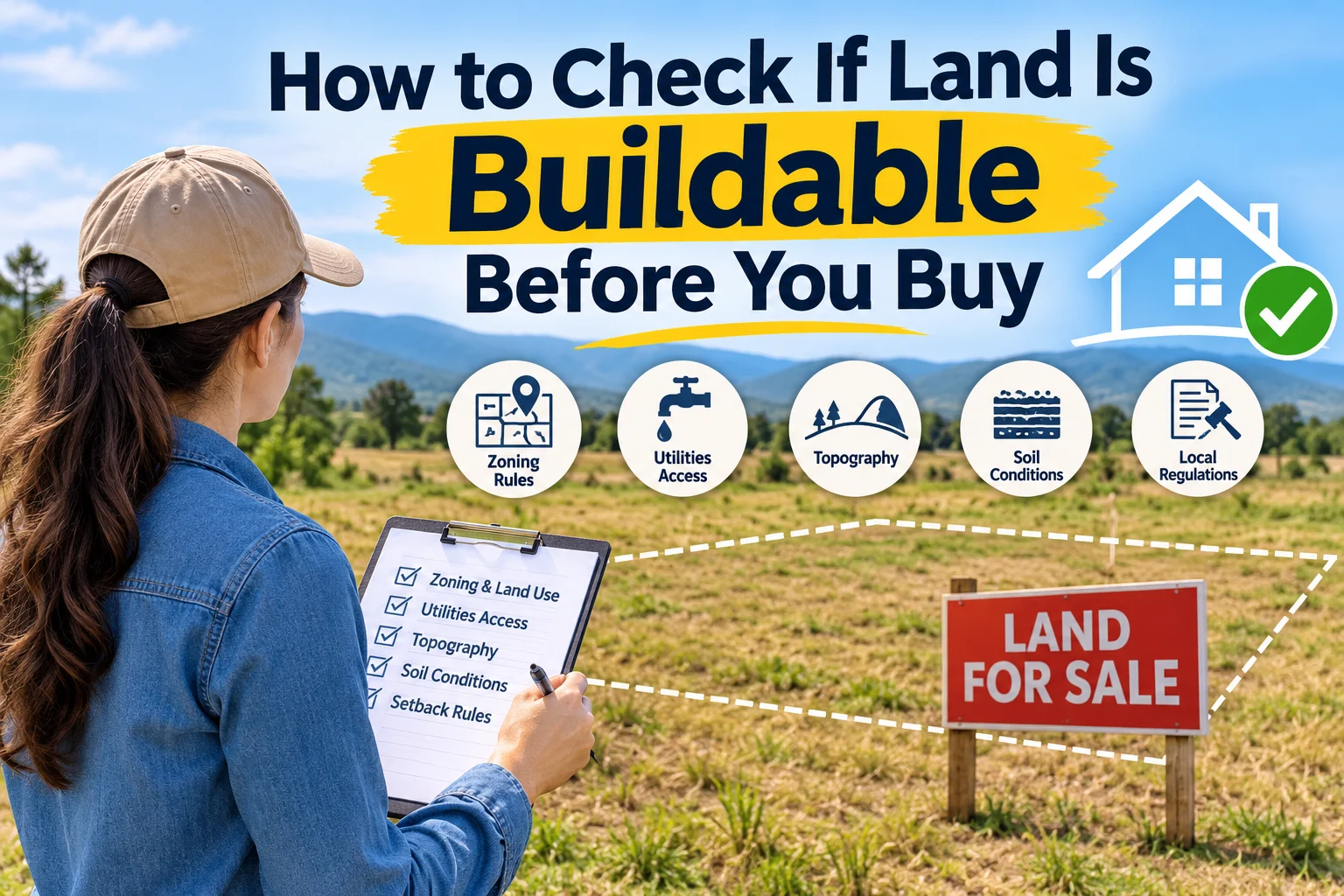
Yes, you can build a house on your land if it passes four tests: the county’s zoning allows a home, you have legal access from a road, the soil can take a septic system (or sewer is available), and enough of the parcel sits outside flood zones, wetlands and setbacks to fit the house. Fail any one of those and the lot may be unbuildable, or buildable only at a cost that changes the deal.
This guide is for anyone buying vacant land to build on, or holding land they hope to build on, with extra detail for South Carolina. By the end you will know which offices to call, which tests to order, what each one tells you, and the order to do them in so you spend the least before you know the answer.
What is a buildable lot, and what makes land unbuildable?
A buildable lot is a parcel where you can legally get a building permit for the structure you want and physically put it there with water, wastewater and power. Both halves matter. Land can be legal to build on but impractical, or physically fine but blocked by a rule.
Unbuildable land is a parcel where at least one requirement for a permit cannot be met. Common causes are a failed septic evaluation with no sewer nearby, no legal road access, zoning that does not allow a home, or a parcel that sits almost entirely in wetlands, a floodway or a setback.
There is a middle category that catches most buyers: land that is buildable with conditions. An engineered septic system, a driveway easement, raised foundations in a flood zone or a long power line extension can all make a lot buildable, but each adds cost and time. The point of checking first is to find out which of the three categories your parcel falls in before you pay for it.
How to find out if land is buildable: the 9-point checklist
To know if land is buildable, check nine things, most of them with a phone call or a free online map before you spend money on tests. The table shows each check, who answers it, and the result that should stop you.
| # | What to check | Who answers it | Red flag that can make the lot unbuildable |
|---|---|---|---|
| 1 | Zoning and permitted use | County or city planning and zoning office | Zone does not allow a single-family home or your home type (for example a manufactured home) |
| 2 | Minimum lot size, frontage and setbacks | Same office, zoning ordinance | Lot is smaller than the minimum, or setbacks leave no room for the house |
| 3 | Legal road access | Deed, plat, title search, real estate attorney | No recorded easement or road frontage; access is only a path across a neighbor’s land |
| 4 | Septic suitability (or sewer) | State or county health/environmental agency; in SC, SCDES | Soil fails the evaluation and no sewer line is close enough to connect |
| 5 | Drinking water | Water utility, or a well driller and the state well program | No water line and poor or salty groundwater |
| 6 | Power and other utilities | Electric utility or co-op | Line extension cost that breaks the budget |
| 7 | Flood zone | FEMA Flood Map Service Center, county floodplain manager | Building site is in a floodway, or the whole lot is in a high-risk zone |
| 8 | Wetlands and protected areas | National Wetlands Inventory map, US Army Corps of Engineers; in coastal SC, SCDES Bureau of Coastal Management | Building site or driveway route crosses jurisdictional wetlands or a critical area |
| 9 | Deed restrictions, HOA covenants, easements | Title report, recorded covenants, county register of deeds | Covenant bans your home type, or an easement runs through the only building spot |
Two more items belong on every list even though they are not legal tests: the slope and soil of the building site, and the total cost to make the lot ready. A parcel that passes all nine checks can still be a poor buy if clearing, grading, a long driveway and an engineered septic system cost more than the land.
1. Zoning, setbacks and minimum lot size
Zoning is the first check because it decides whether a home is allowed at all. Call the planning and zoning office for the county (or the city, if the parcel is inside city limits) and give them the parcel or tax map number. Ask four questions:
- What is the zoning district for this parcel, and is a single-family home a permitted use? Agricultural zoning often allows a home, but building a house on agricultural zoned land has its own conditions.
- Is my type of home allowed? Manufactured homes, tiny homes and RVs are often treated differently from site-built houses.
- What are the minimum lot size, road frontage and setbacks from the front, side and rear lines?
- Is this a legal lot of record, or was it split off in a way the county did not approve?
Setbacks shrink the usable area. Subtract them, then subtract any easements, and what is left is your buildable envelope. On a narrow or irregular lot that envelope can be smaller than the house you want.
Ask for the answer in writing, or note the name of the person you spoke to and the date. A zoning verification letter is worth having if you are paying a deposit.
In South Carolina, both counties and cities can adopt zoning, and many rural counties zone only part of their land or none at all. Union County, for example, has no zoning according to the National Zoning Atlas. No zoning does not mean no rules, and the same goes for land sold as unrestricted land. You still need a septic permit, a building permit and code inspections.
2. Legal road access and easements
A lot needs legal access, not just a dirt track you can drive on today. Legal access means the parcel either fronts a public road or has a recorded easement across other land to one. Without it, many counties will not issue a building permit, lenders will not finance the house, and a neighbor can close the track at any time.
Check three things:
- The deed and plat. Look for road frontage or a written access easement with its width and route.
- The title report. A title company or real estate attorney can confirm the easement is recorded and runs to a public road.
- The physical route. Walk it. A recorded easement through a creek bottom or swamp may be legal but very costly to turn into a driveway.
Easements can also work against you. A utility, pipeline or timber company may have a recorded right to cross your land. Find out where each easement runs, because you usually cannot build on top of one.
3. Septic suitability and well water
If there is no public sewer, the septic evaluation is the test most likely to make rural land unbuildable. Ask the health or environmental agency whether the soil can take a conventional system, an engineered one, or none. People still call this a perc test, though many states now use a soil evaluation with test pits or borings.
The result also decides where the house can go. The drain field and its repair area need space, plus setbacks from wells, property lines and the house. On a small lot, the septic layout can force a smaller house or a two-story plan.
In South Carolina, septic permits come from the SC Department of Environmental Services (SCDES), which took over the program from DHEC in July 2024. SCDES says plainly that without its septic permit, the county cannot issue you a building permit. The process from the SCDES application packet:
- Apply online or by mail with the plat or deed showing the lot’s dimensions, the owner’s signed permission letter, and a sketch of the proposed house, septic area, wells and driveway. The application fee is $150.
- Prepare the site. Stake the property corners and the house footprint, mark property lines with flagging, post the location cards, and clear underbrush for 150 feet around the proposed septic area. Skipping these steps can cost a second $150 fee and send you back to the end of the queue.
- If the parcel is above the SC Fall Line (the Piedmont and Upstate), you must have a backhoe operator dig test pits at the evaluation. SCDES staff tell the operator where to dig on the day, so do not dig early.
- If the site passes, SCDES mails a Permit to Construct, which is good for five years. If it fails for a conventional system, SCDES sends a letter with other options, such as an alternative system design.
Visits are scheduled first come, first served, and rain can delay them because wet soil is less likely to pass.
Water. If there is no water line, you will need a well. In South Carolina, wells must be drilled by a state-certified driller, and SCDES must receive a notice of intent before the well is installed, per its private well program. Ask nearby owners or a local driller how deep wells run and whether the water quality is good. Keep the well site in mind when planning the septic layout, because the two must be kept apart.
4. Power, water lines, sewer and internet
Utilities rarely make land legally unbuildable, but distance to them can make it too costly. Find the nearest pole and the nearest water and sewer lines, then call the providers with the parcel number.
- Electricity. Ask the utility or electric co-op for a written estimate to run service to your building site, not just to the property line. Long runs through woods can cost far more than the buyer expects.
- Public water and sewer. Ask whether the parcel can connect, the tap or impact fees, and who pays to extend the line. Some local rules require a home within a set distance of a sewer line to connect to it.
- Internet and cell service. Not required for a permit, but it matters for daily life, resale and remote work. Check provider maps and test your phone on site.
If you plan to go off-grid with solar and a well, confirm the county will still issue a permit and certificate of occupancy for that setup.
5. Flood zones, wetlands and slope
These three can turn a buildable-looking parcel into one with only a small buildable corner, or none. You can screen all three for free before you spend anything.
Flood zone. Look up the parcel on the FEMA Flood Map Service Center. A high-risk zone (those starting with A or V) usually means the house must be raised to a set elevation, you will need an elevation certificate, and a lender will require flood insurance. A floodway is stricter, and building there is often blocked. Ask the county floodplain manager what applies to your exact building site. A parcel can be partly in a flood zone, so check where the high ground sits.
Wetlands. Check the US Fish and Wildlife Service National Wetlands Inventory map for a first look. It is a screening tool, not a ruling. Filling or building in federally regulated wetlands generally needs a permit from the US Army Corps of Engineers. If wet ground sits where the house or driveway would go, a wetland delineation by a consultant gives you a real answer.
Slope and soil. Steep ground means grading, retaining walls or a stepped foundation, and it can limit septic placement. Low, wet ground can mean fill and drainage work. The USDA Web Soil Survey shows soil types and limitations for any parcel for free. For a steep or unusual site, a civil engineer or geotechnical engineer can tell you what the foundation will need.
Coastal South Carolina. In the eight coastal counties (Beaufort, Berkeley, Charleston, Colleton, Dorchester, Georgetown, Horry and Jasper), the SCDES Bureau of Coastal Management regulates the critical areas: coastal waters, tidelands, beaches and the beach/dune system. Altering a critical area requires its permit. If your parcel touches marsh or tidal water, ask where the critical area line falls before planning the house, a bulkhead or a dock.
6. Deed restrictions, HOA covenants and title
Private rules can block a build even when zoning allows it. Restrictive covenants and HOA rules are recorded with the deed or the subdivision plat and bind every later owner. They may set a minimum house size, ban manufactured homes, require architectural approval or limit outbuildings and animals.
Ask the seller for a copy of any covenants, then confirm them through a title search. A title report also shows liens, unpaid taxes, recorded easements and any gaps in ownership. A real estate attorney can read the restrictions against your plans and tell you whether your house fits.
Finally, confirm the boundaries. A boundary survey shows where the corners and lines are and where recorded easements cross. It is the document that lets you check that your planned house, well and drain field all fit inside the lines and outside the setbacks.
Can unbuildable land be made buildable?
Sometimes. Some problems have a fix that costs money and time; others are close to permanent. Know which kind you are facing before you negotiate.
| Problem | Possible fix | How fixable |
|---|---|---|
| Soil fails a conventional septic evaluation | Alternative or engineered system designed by a licensed engineer and approved by the agency; or connect to sewer | Often fixable, at higher cost |
| No legal road access | Buy or negotiate a recorded access easement from a neighbor; a court action may be possible in some cases | Depends on neighbors; get an attorney |
| Zoning does not allow a home | Apply for a rezoning, special exception or variance | Uncertain; involves public hearings |
| Lot below minimum size or frontage | Variance, or combine with an adjoining parcel | Uncertain |
| Building site in a flood zone | Build above the required elevation; use a different spot on the lot | Usually fixable, with higher build and insurance costs |
| Building site in a floodway or wetlands | Move the house to upland ground; wetland permits are possible but slow | Hard if there is no upland area |
| Covenant bans your home type | Ask the HOA or other lot owners to amend; usually unrealistic | Rarely fixable |
| Power too far away | Pay for a line extension, or go solar | Fixable at a cost |
If a fix depends on a future approval, such as a variance or an engineered septic permit, get that approval or make your purchase depend on it. Do not buy on the hope that it will come through.
What to consider when building on your land in South Carolina
In South Carolina, the order of approvals matters: zoning first, then the SCDES septic permit, then the county building permit. Here is who handles each step.
| Step | Who handles it in SC | What to know |
|---|---|---|
| Zoning | County planning and zoning, or the city inside city limits | Some rural counties have little or no zoning. Where zoning exists, counties such as Abbeville issue a zoning compliance permit before any building permit. |
| Septic | SCDES (formerly DHEC) | $150 application, site evaluation, Permit to Construct valid 5 years. Required before the county issues a building permit, including for a manufactured home. |
| Private well | SCDES private well program | State-certified driller; notice of intent to SCDES before drilling. |
| Coastal critical areas | SCDES Bureau of Coastal Management | Applies in the 8 coastal counties to marsh, tidelands, beaches and dunes. |
| Building permit and inspections | County or city building department | Work generally must be done by contractors licensed through SC LLR, unless an exemption applies. |
Where in the state you are changes the risks.
- Upstate and Piedmont (above the Fall Line). Clay soils and rock are common. SCDES requires backhoe test pits for septic evaluations here, so budget for a backhoe operator. Slope and rock can also raise foundation and driveway costs.
- Midlands and Sandhills. Sandy soils often drain well for septic, but check for slopes near streams and confirm whether you are near a sewer line around growing towns.
- Lowcountry and coast. Flat ground, high water tables, flood zones and marsh are the main issues. Expect closer scrutiny of septic sites, possible elevation requirements, and coastal permits near tidal water.
Budget for the septic system, not just the permit. An industry cost guide puts SC septic installation at about $5,000 for a basic conventional system to $15,000 or more for advanced systems in the Lowcountry. Treat those as rough figures and get local installer quotes.
Manufactured homes. They need the same SCDES septic permit before the home can be moved onto the property. Zoning and covenants are where manufactured homes are most often restricted, so ask about your home type by name.
In what order should you check, and how long does it take?
Do the free checks first, then pay for tests only once the parcel has passed them. That way a deal-breaker costs you a phone call, not a survey and a septic evaluation.
- Free screening (a day or two). Pull the parcel on the county GIS map, look it up on the FEMA flood map and the wetlands and soil maps, and call zoning with the parcel number.
- Paperwork (about a week). Get the deed, plat, any covenants and any earlier survey from the seller or the register of deeds. Ask a title company or attorney about access and easements.
- Utility calls. Get written answers on power, water and sewer, including line extension costs.
- Paid tests (weeks). Apply for the septic evaluation and order a boundary survey. These take the longest, so start them as soon as the free checks pass.
- Walk the land with a builder. A builder can spot slope, drainage and layout problems that a map will not show, and tell you whether your house plan fits.
How long all this takes depends on the parcel. A land broker interviewed by Raydient Rural put it at a week or two for a simple roadside lot in a lightly zoned county, and up to 30 to 45 days for a parcel that needs easements, a road and a perc test. Ask for a due diligence period long enough to cover the slowest item.
Buying with owner financing. Make the purchase agreement depend on the land being buildable before you pay the down payment. Write in the specific tests (septic approval, survey, zoning confirmation) and a date by which they must be done, with your deposit returned if any fail. After the papers are signed, an unbuildable lot is your problem, and you would be making monthly payments on land you cannot use. Have a real estate attorney in that state check the clause, and ask the seller for any earlier perc test, survey or septic permit, which can save weeks.
Sources and how this guide was researched
South Carolina permit steps, fees and validity periods come from SCDES’s own pages and application packet, checked in November 2026. Rules change, and counties differ, so confirm current requirements with the offices named above before you rely on them. This guide is general information, not legal or engineering advice.
- SCDES: Septic Tanks, Residential Single Home Builder
- SCDES: Onsite Wastewater (Septic System) Application Packet, D-1740
- SCDES: Private Drinking Water Wells
- SCDES: Bureau of Coastal Management
- SCDES: Critical Area Permitting
- National Zoning Atlas: Union County, SC
- Abbeville County, SC zoning ordinance, Chapter 5 (via Zoneomics)
- Septic & Well Pro: Septic Installation Cost in South Carolina (2026)
- Septic & Well Pro: How to Get a Septic Permit in South Carolina
- Raydient Rural: Due Diligence, How to Make Sure Your Land Is Buildable
Frequently Asked Questions
Can I build a house on my land if it has no zoning?+
Possibly, but no zoning does not mean no permits. You still need a septic permit (or sewer), a building permit and inspections, and any deed restrictions still apply. Call the county building department to confirm what it requires.
How do I know if land is buildable before I buy it?+
Run the free checks first: zoning, flood map, wetlands map and road access. Then make your offer depend on a passed septic evaluation, a boundary survey and a clear title report, with your deposit refundable if any of them fail.
What does it mean when a lot is unbuildable?+
It means you cannot get a building permit for a home on it as things stand. The usual causes are failed septic soils with no sewer, no legal access, zoning that does not allow a home, or no usable ground outside wetlands, floodways and setbacks.
Is a lot buildable if there was a house on it before?+
Not necessarily. Rules may have changed since then, an old septic system may not meet current standards, and a lot that was legal under old zoning may now be below the minimum size. Check it like any other lot.
How long is a South Carolina septic permit good for?+
A Permit to Construct from SCDES is good for five years. After that, or to change it, you must apply again and pay the fee again.
Can I put a mobile home on my land?+
It depends on zoning and any covenants, which are the most common restrictions on manufactured homes. In South Carolina you also need the SCDES septic permit before the home is moved onto the property.